


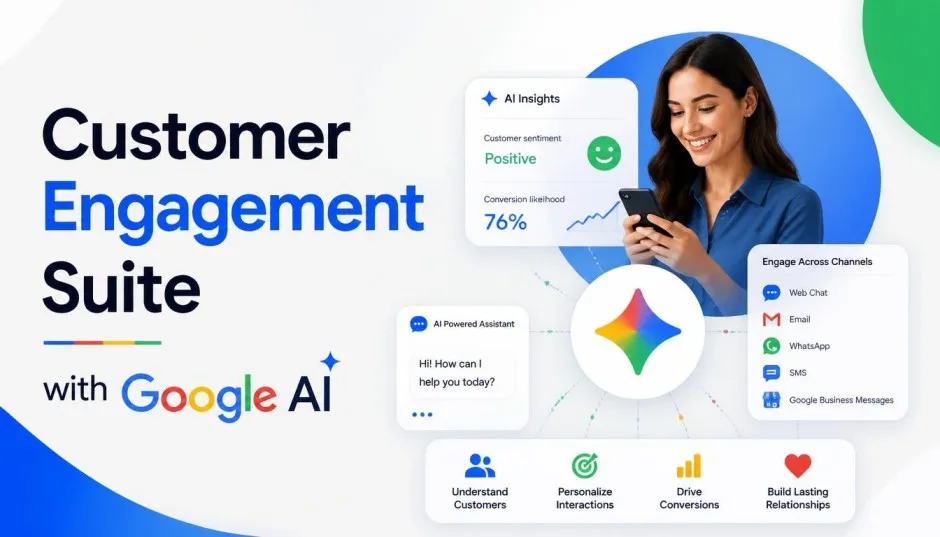
Supercharge Your Customer Engagement Suite with Google AI
I spent three weeks last year trying to untangle a client's support stack. They had one vendor for chat, another for voice, a third for analytics, and a spreadsheet to glue it all together. Every handoff lost context.
Every escalation made the customer repeat themselves. When I saw Google's rebuilt customer engagement suite with google ai, that mess was the first thing I thought of.
The pitch is simple: one platform, one context, agents that actually do things instead of just answering questions. The reality is more nuanced. Here is what the documentation and real user feedback actually say.
What Google Actually Built (And Why It Matters)?

Google didn't just bolt AI onto an old contact center product. It rebuilt the suite around Gemini Enterprise for Customer Experience, a unified agentic platform that merges shopping, commerce, and customer service into a single interface.
Read Also: Google Business Suite Pricing: A Complete Guide
The company announced it at NRF 2026 in January. The core shift is from chatbots to agents. Older bots answered single questions. These agents reason, plan, and act across the full customer lifecycle.
They can handle product discovery, build a cart, apply a promotion, and resolve a post-purchase issue without losing context. That's a different category of tool.
The platform deploys pre-built, configurable agents in days, not months. Google says customer data is not used for model training, and built-in safeguards enforce brand and legal policies.
The Four Pieces You Actually Get
The suite breaks into four working parts. Each solves a different problem.
Customer Experience Agent Studio is where you build agents. It combines generative AI with deterministic functions. You use it to create self-service agents that handle high-volume inquiries and free human reps for complex calls.
Agent Assist sits on the rep's desktop. It provides real-time coaching, generated responses, summaries, smart replies, and live translation. The goal is faster, more accurate resolution without the rep digging through knowledge bases mid-call.
Customer Experience Insights analyzes real-time data across operations. It surfaces KPIs, flags priority inquiry categories, and identifies call drivers and sentiment. Operations managers and QA teams use it to spot problems before they compound.
Commerce Agents connect front-end chat and voice directly to backend tools. They handle complex reasoning and execute consented actions. This is the piece that turns a support interaction into a transaction.
How Google AI Transforms Customer Engagement?

Google's own documentation is polished. Independent proof is harder to find. But one verified review on Gartner Peer Insights gives a concrete data point.
You Must Also Like: The Best Google AI Plus Subscription: Smart Features And Pricing
A general management reviewer from a transportation company under $50M in revenue reported that the Google customer engagement suite decreased staff workload and handling times.
The same review cited strong integration with existing systems and helpful assist tools as the main reasons. That's one review. It's not a pattern. But it aligns with what Google claims the suite does: reduce rep effort and speed up resolution.
The more interesting data comes from UJET, a Google Cloud OEM partner that integrated CX Agent Studio. UJET reports customers deploying sophisticated AI agents in as little as four weeks, compared to industry averages of three to six months.
Case studies cited include KeyBank achieving a 15% call volume reduction and 10% contact center cost decrease, and EverWash cutting average response time from over 60 seconds to 18 seconds.
Those numbers come from a partner with a stake in the platform's success. Treat them as directional, not definitive.
The Cost Problem Nobody Publishes
This is where the honest conversation starts. Google does not publish pricing for Gemini Enterprise for CX. You have to request a quote. That means a sales conversation before you can compare it to anything else.
One independent review put it bluntly: the compute bill is not the expensive part. The engineering time to build and maintain what you deploy usually dwarfs it.
Compared against a per-resolution competitor at $0.99, Google may be cheaper per unit and more expensive in total once you count the engineers.
The review also advised asking two questions on the sales call: what triggers a billable event, and what the rate is at twice your current volume. That's practical advice. Cloud billing is hard to forecast. AI agent billing is harder.
Who This Is For (And Who Should Wait)?
This fits you if you are already on Google Cloud. The suite connects natively to BigQuery, Dialogflow, and Google's data tools. The integration story is real, and the Gartner reviewer specifically praised it.
This fits you if you have engineering resources to build and maintain agents. The "deploy in days" claim refers to pre-built agents. Customizing them, connecting them to your backend, and keeping them updated is ongoing work.
This does not fit you if you need predictable per-seat pricing. Google's usage-based model with unpublished rates is a budgeting problem. Smaller teams without dedicated cloud engineers may find the total cost of ownership higher than a simpler CCaaS product.
This does not fit you if you need proven case studies at scale. The platform is new. The UJET data is partner-reported. The Gartner review is a single data point. Early adopters are taking a measured risk.
The Final Thoughts
Start with the Agent Assist piece, not the full platform. It's the lowest-risk entry point. It sits on top of your existing contact center and gives reps real-time help without ripping out your phone system . If that works, expand to Agent Studio.
Don't buy the "days to deploy" line without asking what "deploy" means. Pre-built agents go live fast. Agents connected to your CRM and order management system take longer. UJET's four-week timeline is realistic for a scoped project, not a full migration.
And get the billing trigger in writing before you sign. Usage-based AI pricing can surprise you when volume spikes. The platform is capable. The cost model is opaque. Go in with your eyes open.
The google customer engagement suite is a serious product for companies already invested in Google's ecosystem. It's not a plug-and-play upgrade for everyone else. The context problem it solves is real. The cost problem it creates is also real.